
Elmbridge's refusal of 206 homes at Moore Place, Esher, cannot be issued until the housing secretary has had 21 days to consider calling it in, minutes show.
Elmbridge’s refusal of up to 206 homes on the former Moore Place Golf Course in Esher is not yet final. Councillors voted to refuse on 13 October. The housing secretary must now be consulted, and can take the decision away from the council altogether.
The minutes of the Planning Committee are now published. They record the resolution as a refusal of outline permission “contrary to the officer’s recommendation”, with five reasons, “and being subject to referral to the Secretary of State”.
On Monday the council’s planning register still listed application 2025/3373 as “Under Consideration”, with no decision date.
Why it has to go to the government
A new government direction took effect this year for large housing schemes. The Town and Country Planning (Consultation) (England) Direction 2026 was published on 31 March. It covers any application for 150 or more homes that had not been decided by 11 May 2026.
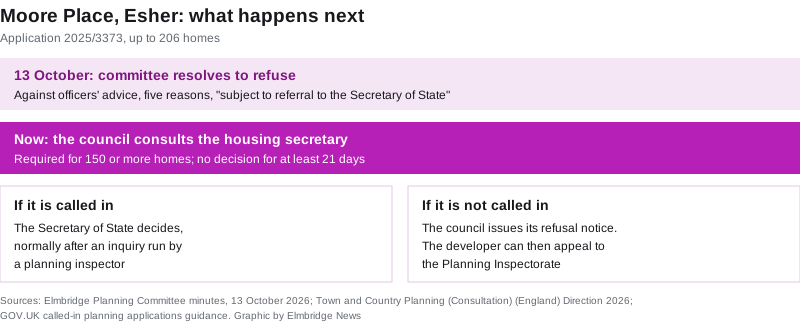
The direction says that where a council “proposes to refuse” such an application, it “must consult the Secretary of State before determining the application”. The council must then wait at least 21 days before it issues a decision.
Moore Place is caught because it proposes up to 206 homes. Before May, a council refusing a scheme like this simply issued its decision notice.
What a call-in would mean
If the Secretary of State calls the application in, the government makes the decision instead of the council. The government’s guidance on called-in applications says the Planning Inspectorate then writes to the applicant and the council to set the inquiry procedure and timetable. An inspector hears the case and the Secretary of State decides it.
If the application is not called in, the council can issue its refusal. Only then would the developers, Charterhouse Strategic Land and Moore Place Holdings, be able to appeal.
The direction does not say how the government will choose which refusals to take over. Neither the council nor the government had published anything on Moore Place’s referral when we checked on Monday.
The five reasons in the minutes
The minutes give the committee’s main reason in full. The development “fails to preserve the setting of Esher Historic town and contributes strongly to Purpose D of the Green Belt and therefore fails to meet the criteria of Grey Belt”. Purpose D is the Green Belt purpose of preserving the setting and special character of historic towns.
The other four reasons cover the lack of a completed legal agreement to secure:
- affordable housing and open green spaces
- a £14,017.40 fee for monitoring the biodiversity net gain
- the payment to protect the Thames Basin Heaths
- money for public rights of way and a travel plan auditing fee
The minutes also show that officers proposed a condition capping the scheme at 206 homes, to give certainty about how much could be built.
The minutes do not record how individual councillors voted, or the numbers on each vote. Our report from the meeting took the sequence of four votes from the council’s webcast.
Not the only big scheme in the borough
The threshold is 150 homes, so not every large Elmbridge scheme is caught. Woodstock Lane North in Long Ditton, up to 144 homes, falls just below it. That application was refused in March and is now at appeal, where the council says it has little or no prospect of defending its decision.
Separately, from 31 October new national rules change which applications councillors decide at all. Those are explained in our guide to the planning delegation changes.
What it means for you
- The refusal stands as a resolution, not yet a decision. Nothing can be built, and nothing has been approved.
- The government may now decide the case. If it is called in, there will be an inquiry, and objectors can take part. We will report the procedure and any deadline to register.
- If it is not called in, the council will issue its refusal notice, and the developer has the usual route of appeal.
We will check the planning register and GOV.UK again next week. Other schemes are on our Elmbridge planning news page.
Sources
- Elmbridge Borough Council, printed minutes of the Planning Committee, 13 October 2026: the resolution, the referral to the Secretary of State, the five reasons, the 206-home condition.
- Elmbridge planning register, application 2025/3373: status “Under Consideration”, read 26 October 2026.
- GOV.UK, The Town and Country Planning (Consultation) (England) Direction 2026, published 31 March 2026, and the direction itself: the 150-home threshold, the 11 May start and the 21-day wait.
- GOV.UK, called-in planning applications: what happens if the application is called in.
- GOV.UK, appeal a planning decision: the developer’s appeal route.
Have your say